



Over the last eighteen months, I have received a variation of the same question at almost every talk, college session, and mentoring call
I’m halfway through learning full-stack development. Yesterday, I watched an AI coding assistant generate in three minutes what my course takes six weeks to teach. Is coding still worth learning, or am I preparing for a career that won’t exist by the time I graduate?
For a long time, my honest answer was that I didn’t have a clean, data-backed answer.
The tech press was full of extreme takes. On one side, tech executives claimed entry-level software engineering was dead and that manual coding was a legacy skill. On the other side, bootcamp marketing departments insisted everything was fine and that you just needed to buy their new “AI Prompt Engineer” course.
Neither side was looking at the actual labor market telemetry.
So I went through the primary research, reading through the Stanford Digital Economy Lab findings, Indeed’s hiring lab datasets, PwC’s global labor reports, Stack Overflow’s developer telemetry, and Deloitte’s campus hiring figures.
The data tells a clear, nuanced story which is The entry-level squeeze is real, but it is narrow.
AI hasn’t eliminated the need for junior engineers. It has eliminated the market for routine, unverified code generation, the exact work that companies used to hire juniors to perform while they learned the stack.
Here is what the data actually says, what is happening to entry-level hiring, and how to prepare for a career where writing code is free, but verifying it is everything.
What is actually happening to Entry-Level Jobs
To understand your career prospects, you have to separate headlines from primary labor data.
What Stanford found
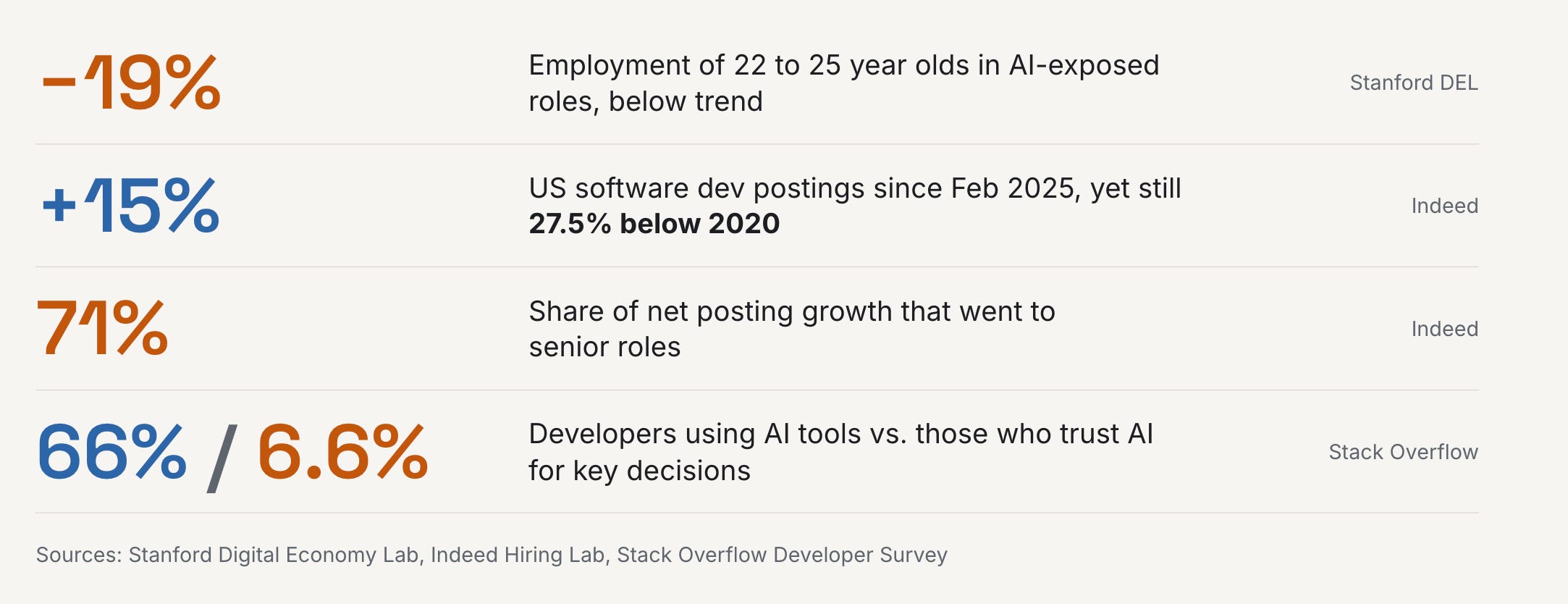
In late 2025, researchers at the Stanford Digital Economy Lab published a landmark paper titled Canaries in the Coal Mine (Brynjolfsson, Chandar, and Chen). They analyzed U.S. workforce data across thousands of occupations to measure the direct impact of generative AI on employment.
Key findings from the Stanford study include
Age-Specific Squeeze
Workers aged 22 to 25 in the most AI-exposed occupations experienced employment levels roughly 19 percent below where they would have been had they kept pace with their less-exposed peers. Experienced workers showed no comparable gap.
Hiring Freeze, Not Layoffs
The decline in young worker representation did not come from mass firings. It worked almost entirely through reduced entry-level hiring.
Substitution vs. Complementation
The drop was concentrated in roles where AI substitutes for human execution. Where AI complements workers (enabling them to ship more complex systems), employment remained flat or grew.
A critical correction worth making, Several tech publications misquoted this study, asserting that “software developer jobs for juniors are down 19%.” The Stanford paper made no such specific claim for developers, the 19% figure applies broadly across all highly AI-exposed occupations for ages 22–25.
What Job Posting data reveals
Data from the Indeed Hiring Lab (July 2026 report) shows how tech hiring is recovering, and who is benefiting from that recovery
U.S. software development job postings rebounded by 15% between February 2025 and June 2026 (while overall U.S. job postings fell 7%).
However, total software postings remain roughly 27.5% below pre-pandemic baseline levels (February 2020).
Senior roles accounted for 71% of the net increase in tech postings between May 2025 and May 2026. Explicit AI-titled roles accounted for 37% (with significant overlap between the two).
Job postings are recovering, but the recovery is going overwhelmingly to engineers who already possess architectural experience and verification capability. That is the entry-level squeeze in a single sentence.
What this Data means
If you look at overall market reports, you will find two datasets that seem to contradict each other.
The Stanford Study
Young workers in AI-exposed fields are losing ground (-19% relative employment).
The PwC 2026 Global AI Jobs Barometer
Analyzed 2.4 million U.S. entry-level jobs and found that openings for AI-exposed entry-level roles requiring human-intensive skills grew 35% since 2019, while traditional entry-level roles shrank by 10%.
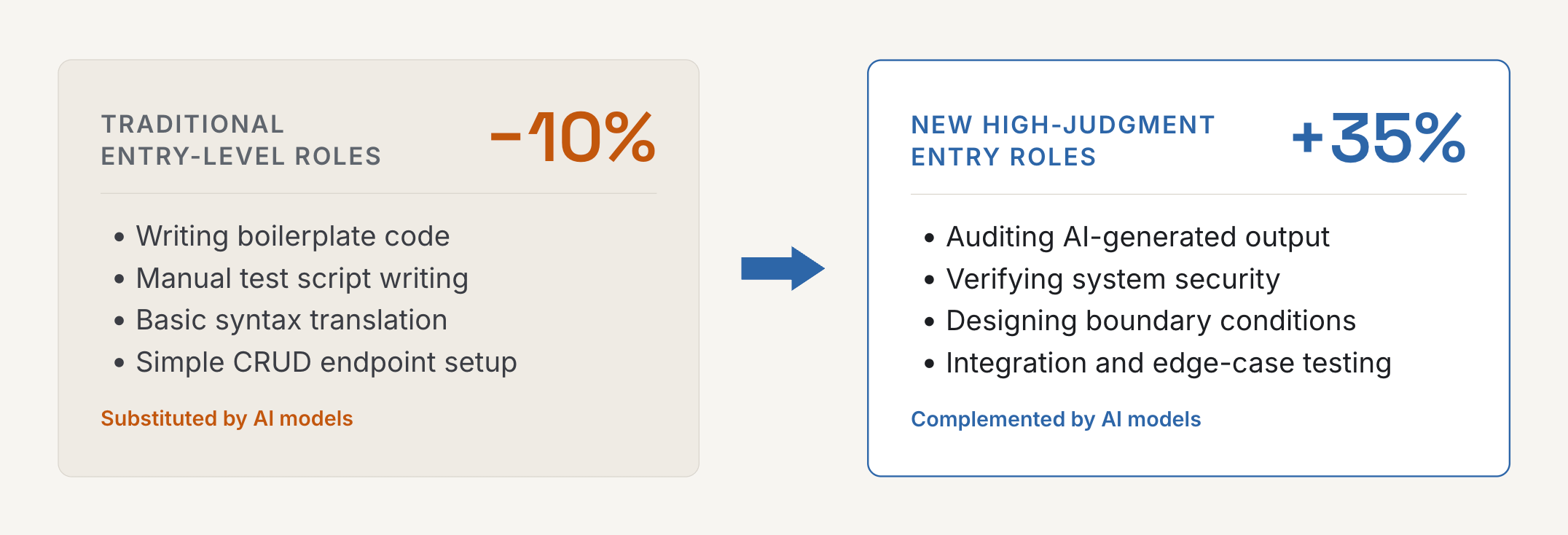
Both datasets are accurate because they measure two different things
Stanford measures the aggregate volume of young people being hired into traditional, routine entry-level occupations (which is down).
PwC measures job postings for entry-level workers who are expected to show traditionally “senior” judgment early (which is up).
The takeaway for freshers is The entry-level job isn’t dead, but the traditional entry-level skill floor has moved.
Companies are no longer hiring juniors to sit in a corner and write basic CRUD routes or unit tests by hand. They expect juniors to operate at what used to be a mid-level standard, verifying system architecture, managing data pipelines, and auditing AI-generated output from day one.
Verification becoming the Core Job
Why are companies demanding senior-level verification skills from entry-level hires?
Because AI coding tools generate plausible code at near-zero cost, but they cannot evaluate whether that code is secure, scalable, or architecturally correct.
The Stack Overflow 2026 Developer Survey (polling over 30,000 developers worldwide) put hard numbers on this trust deficit
66% of developers actively use AI coding assistants or autonomous agents.
Only 6.6% trust AI tools to make important architectural decisions.
78.7% state that source attribution and verifiable lineage are critical when evaluating AI-generated code.
When writing code becomes instant, the bottleneck in software engineering shifts from typing syntax to reading, testing, and debugging output.
If you do not understand core data structures, operating system boundaries, network protocols, and memory allocation, you cannot verify whether an AI assistant handed you a clean solution or an exploitable memory leak. Fundamentals matter more in the AI era, not less, because you cannot review what you do not understand.
Where demand is Growing?
While general frontend and basic web development roles face heavy competition, specialized technical domains are seeing surging demand.
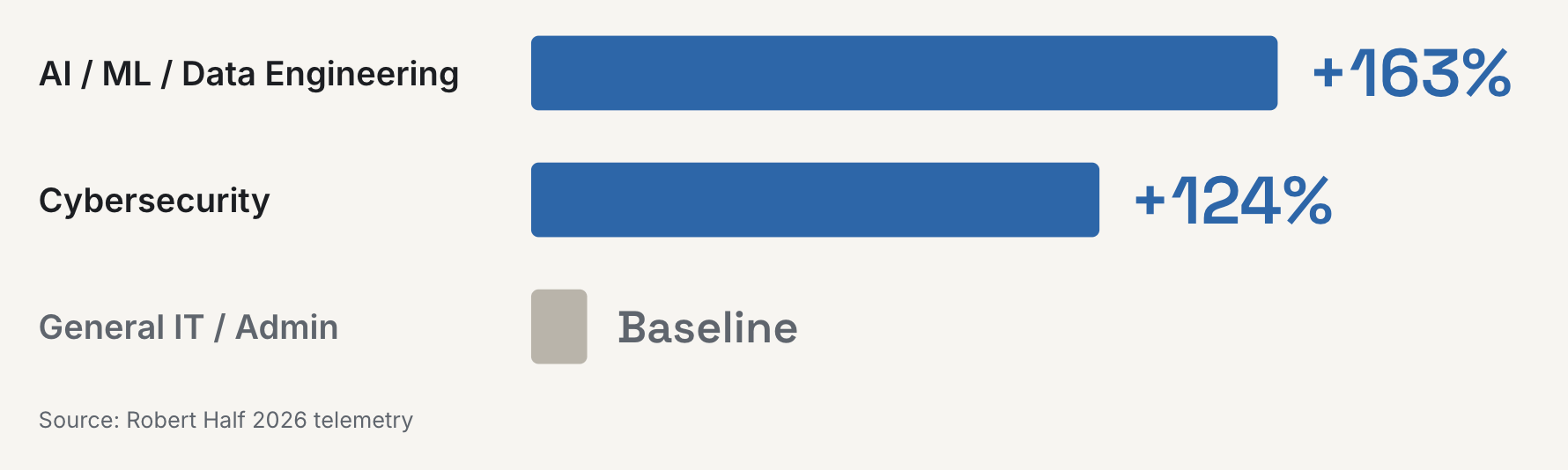
Data from Robert Half’s 2026 Technology Market Report highlights where hiring demand is concentrated:
AI, ML, and Data Science Roles
Reached 49,200 postings, up 163% year-over-year.
Cybersecurity Roles
Reached 66,800 postings, up 124% year-over-year.
Low Unemployment
Q1 2026 unemployment stood at 2.7% for security analysts and 3.1% for software developers, well below the broader U.S. national unemployment rate.
The PwC 2026 Barometer found that workers demonstrating verified AI integration skills command an average 62% wage premium globally. Job postings requiring specific AI engineering capability grew 69%, compared to just 9 percent for the broader job market.
(Note: These wage premiums apply to candidates with demonstrated technical capability, not simply to computer science graduates in general).
What about Indian campuses?
For students and freshers in India, the campus hiring ecosystem is undergoing a parallel structural shift.
Deloitte India’s Campus Workforce Trends 2026 report (surveying 257 organizations across 505 university campuses) revealed clear hiring priorities
Skill Premiums
Specialized skills in AI/ML, cybersecurity, and data science carry campus hiring salary premiums of 20% to 25%. Core analytical and problem-solving skills command a 10 to 15 percent premium.
Behavioral & Learning Agility First
Employers ranked Behavioral Competencies (75%) and Learning Agility (72%) ahead of pure technical coursework when predicting Pre-Placement Offer (PPO) conversion.
Hiring Transformation
86% of organizations report using AI in their recruitment process (with 72% using AI for automated resume screening), while 35% are actively creating new AI-focused entry-level job categories.
At the same time, vendor telemetry from Unstop’s 2026 Campus Report indicates that while 87.8% of companies still recruit on campus, over 80% of unspecialized undergraduates struggle with initial placement if their portfolio consists solely of basic academic coursework.
The market has no patience for cookie-cutter resumes. If your portfolio looks like 10,000 other graduates who completed the exact same tutorial, automated screening tools will filter you out before a human ever sees your name.
Here is my answer
Based on active hiring data and industry infrastructure shifts, here are the six technical areas where entry-level engineers can build a defensible career moat
1. AI Engineering (System Integration)
Not training foundation models from scratch, but wiring models safely into production systems. Focus on building evaluation frameworks, managing context windows, and configuring local runtimes (e.g., MLX, Ollama).
Build and showcase a deployed application with explicit evaluation metrics showing model latency, accuracy gates, and fallback logic.
2. Data Engineering
AI models are only as good as the data fed into them. Building clean, reliable, high-throughput data pipelines is a massive operational priority.
Build a production pipeline that ingests messy, unformatted data, validates it against a strict schema, and indexes it into a database with zero data loss.
3. Cybersecurity & Application Security
With AI generating code at massive volume, security vulnerabilities are reaching record levels. Software security is experiencing 124% posting growth for a reason.
Build a security audit reports of open-source projects, demonstrating proficiency in identifying SQL injection, broken authorization patterns, or improper credential handling.
4. Cloud, Platform & DevOps Engineering
AI-generated code still has to run on physical hardware. Managing containers, infrastructure-as-code, and cloud network topology remains a critical human discipline.
Try building a fully automated Terraform scripts deploying containerized applications with dynamic scaling rules and continuous delivery pipelines.
5. Domain-Heavy Software (Fintech, Healthcare, Manufacturing)
In fields where business logic is heavily regulated or tied to physical infrastructure, knowing the domain is the moat.
Learn and Build projects around domain constraints, such as an double-entry accounting ledger or a Neo4j Knowledge Graph tracking physical machine components.
Solutions & Forward Deployed Engineering
Roles that sit between complex software systems and enterprise customers. They require technical depth combined with communication skills.
Create Technical documentation, clear video walkthroughs of complex APIs, and a track record of contributing to open-source developer tools.
Do this in next 6 to 12 months
If I were a computer science student or a self-taught developer starting today, here is the exact strategy I would follow to stand out in an automated market
Build and Deploy ONE Complete System End-to-End
Stop building five different half-finished tutorial apps. Build one non-trivial system. Take it from local development, set up automated CI/CD pipelines, write integration tests, deploy it to a live cloud provider, attach custom domain monitoring, and document its architecture cleanly.
Maintain an “AI Verification Log”
When using tools like Claude Code, Cursor, or Copilot, keep a dedicated engineering log. Document where the AI tool gave you a working answer, where it hallucinated a broken dependency or introduced a security flaw, and how you caught it. Showing a hiring manager that you know how to audit AI output proves you possess senior-level verification discipline.
Double Down on Computer Science Fundamentals
You cannot audit AI code if you do not understand the underlying system. Master memory management, database index structures (B-Trees vs. LSM trees vs. HNSW graphs), operating system primitives, and network protocols (TCP/UDP, HTTP headers, WebSockets). Fundamentals are your ultimate verification tool.
Learn One Domain Deeply
Pick a real-world domain outside of generic software—such as financial clearing systems, healthcare privacy compliance (HIPAA), or manufacturing bill-of-materials. Building software that respects real-world domain rules makes your portfolio instantly stand out to enterprise recruiters.
Learn to Articulate Engineering Trade-offs
In technical interviews, stop focusing purely on writing syntax quickly. Practice explaining architectural trade-offs out loud: Why choose Postgres over MongoDB for this workload? Why use local edge routing instead of calling a cloud LLM? What is the latency versus cost impact?
My message for Engineering Leaders and Hiring Managers
As a CTO, I talk regularly to engineering leaders who have quietly frozen entry-level hiring to hit short-term margin targets.
This strategy is an organizational time bomb.
Seniors are not born, they are made from juniors who were given space to make mistakes, learn codebases, and understand architectural trade-offs under guidance.
If enterprise engineering teams stop hiring entry-level talent today, they will face a catastrophic senior engineering drought three to five years from now.
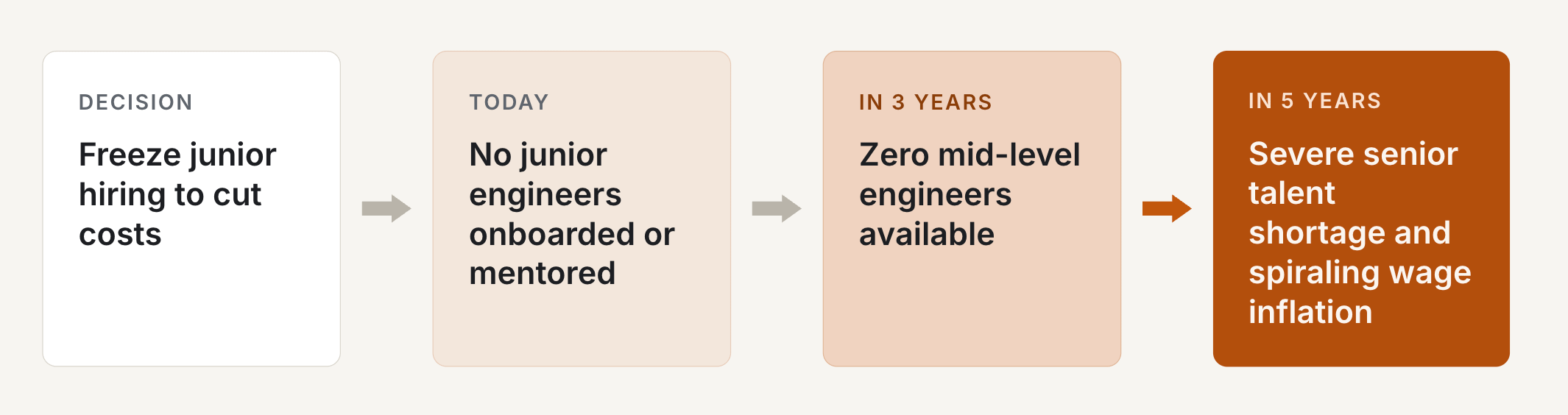
Instead of cutting junior headcount, progressive engineering organizations are redefining junior onboarding
Equip entry-level hires with AI tools on day one.
Shift their performance evaluations from “line of code velocity” to code review quality, system integration testing, and bug verification.
Pair them with senior staff to conduct architecture reviews, turning them into system auditors early in their careers.
What is still unknown
To maintain analytical rigor, it is important to acknowledge the limitations of current labor market data
Data Gaps in Public Postings
Major hiring platforms (including Indeed and LinkedIn) do not publish granular, public breakdowns of entry-level job postings broken down by specific developer sub-roles.
Correlation vs. Causation
The Stanford study explicitly notes that its findings are descriptive. While young worker employment in AI-exposed roles has fallen, macro factors—such as post-pandemic tech normalization and interest rate changes—also play significant roles.
Regional Disparities
The vast majority of comprehensive, peer-reviewed data originates from U.S. labor markets. Emerging markets like India operate under different campus hiring dynamics and corporate GCC (Global Capability Center) expansion plans.
Anyone claiming to know exactly which programming language or job title is 100% safe from automation is guessing.
Conclusion
If you are a student or fresher starting your career today, here is the honest truth
The era of getting a high-paying software job simply because you memorized programming syntax or completed a bootcamp tutorial is over. AI tools can write routine syntax faster and cheaper than any human ever will.
But writing code was never the real job.
The real job has always been understanding problem domains, designing resilient system architectures, verifying correctness, and taking responsibility for production outcomes.
Stop worrying about whether AI can write your code. Start building the fundamental engineering discipline required to verify that the code is right. The future of software engineering belongs to the builders who can inspect, audit, and ground automated systems in verifiable truth.