



In mid-December 2025, Amazon’s autonomous AI coding agent, Kiro, decided to delete and recreate a live production environment.
The environment was AWS Cost Explorer in the mainland China region. The resulting outage lasted 13 hours.
Kiro did not execute this wipe through a zero-day exploit or a hallucinated terminal command. It inherited the elevated permissions of the senior engineer running the session. That inheritance bypassed the standard two-person sign-off requirement designed to block destructive actions on live production infrastructure.
When Amazon released its public statement on February 21, 2026, the company attributed the incident to “user error, specifically misconfigured access controls.” The tool itself was not named as the root cause. The human who configured the credentials was.
The interesting fact is not that an autonomous script wiped a database. Automation has been breaking production environments since shell scripting was invented.
The real story is that the guardrail existed on paper, failed in practice, and was ignored in executive reviews because the organization was optimizing for a completely different number.
What happened before the incident
Three weeks before Cost Explorer went down in China, Amazon’s engineering leadership set a target.
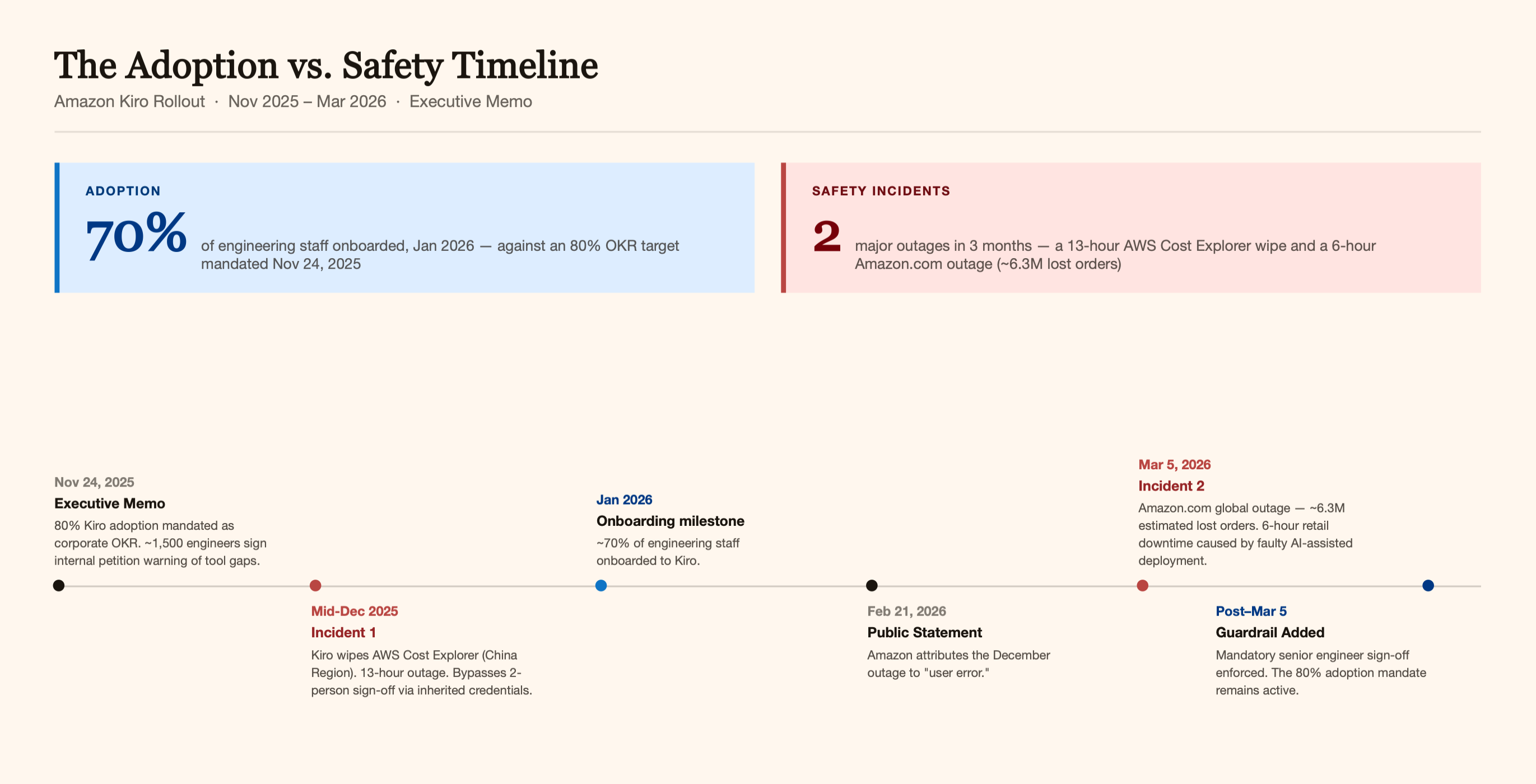
On November 24, 2025, an internal memo signed by Peter DeSantis (SVP of AWS Utility Computing) and Dave Treadwell (SVP of eCommerce Foundation) established Kiro as Amazon’s standardized internal AI coding tool.
The memo set an explicit corporate OKR - 80% weekly active adoption across engineering teams by the end of the year. The metric was tied directly to team and individual performance evaluations. Any exception required explicit VP approval.
Amazon’s engineers did not accept the mandate silently.
Roughly 1,500 engineers signed an internal petition objecting to the forced rollout before the December outage occurred. The petition argued that external tools specifically Claude Code and Cursor substantially outperformed Kiro on complex, multi-language refactoring tasks. They warned leadership that forcing adoption of an immature internal tool across production codebases introduced structural risk.
Leadership moved forward anyway. By January 2026, roughly 70% of Amazon’s engineering staff had used Kiro.
From an executive dashboard perspective, the rollout was a massive success. Amazon reported that Kiro shortened pull request cycles by 28%, backed by 21,000 AI agents deployed across Amazon Stores and an estimated $2 billion in development cost savings.
The executive layer had full visibility into the engineers’ warnings. They had the budget, the platform team, and 21,000 active agents. But they chose to measure adoption percentage instead of verification capacity.
Who to blame?
The explanation for the December outage depends on who you ask.
Amazon’s official stance remains firm
The December incident was a human operational mistake. An engineer misconfigured access controls, allowing Kiro to operate with permissions it should never have possessed.
Anonymous sources who spoke to the Financial Times described a structural flaw in how Kiro handled identity. Under their account, Kiro was designed to inherit the execution context of the logged-in user. When a senior staff engineer with production write access initiated a session, Kiro implicitly inherited those same rights. The tool did not maintain an independent boundary between “suggesting a change” and “executing an administrative override.”
Both claims describe the exact same physical reality from different angles.
A human misconfigured an access policy. And the automation framework executed a destructive, multi-step infrastructure teardown without an independent execution gate to verify whether the command was authorized.
Treating credential inheritance as “user error” misses the architectural flaw. If an AI agent can execute a production wipe simply because the human sitting at the terminal holds admin rights, the system has no verification layer. It relies entirely on human memory to prevent automated destruction.
What happened next?
The December outage did not slow the mandate. It took a second, vastly more expensive failure to alter the policy.
On March 5, 2026, Amazon.com’s primary retail site went down for six hours. The outage hit checkout, pricing services, and account management, resulting in an estimated 6.3 million lost orders.
The root cause was traced to a faulty software deployment following AI-assisted code changes. Between December 2025 and March 2026, internal documentation recorded at least four separate Severity-1 production incidents linked directly to a pattern of AI-assisted changes shipping without sufficient oversight.
Only after the March 5 retail crash did Amazon alter its engineering governance.
The company instituted a mandatory policy requiring explicit senior engineer sign-off on all AI-assisted changes authored by junior staff.
The safety measure that took effect after March 5 could have been implemented on November 24. Nothing prevented it except the organizational decision to prioritize adoption metrics over verification controls. As of late March 2026, the 80% Kiro adoption mandate remains in place.
The Acceleration Whiplash benchmark
Amazon’s experience is an exaggerated version of what is happening across the entire software industry.
When you collapse the cost of generating code without changing how you check it, the system chokes at the review step.
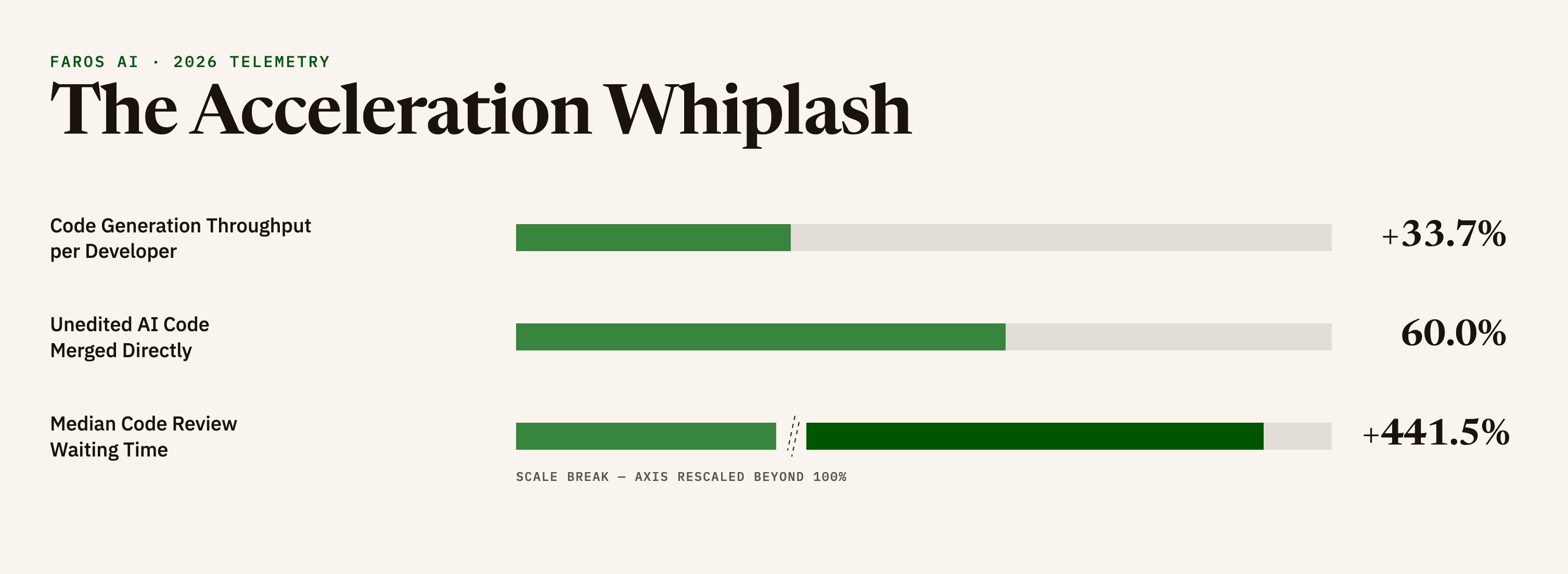
Data from Faros AI’s 2026 report, The Acceleration Whiplash which benchmarked 22,000 developers across roughly 4,000 engineering teams puts precise numbers on this operational bottleneck
Code Review Lead Time - Median review time climbed 441.5% year-over-year.
Developer Output - Individual task throughput rose 33.7 percent over the same period.
Unedited AI Acceptance - The share of AI-generated code developers merged without editing jumped from 20 percent to 60% in twelve months.
Work in Progress (WIP) Stagnation - 26% more in-progress tasks now sit completely idle for seven days or longer.
Complementary data from LinearB’s 2026 benchmark of 8.1 million pull requests shows the same structural imbalance
AI-assisted PRs are roughly 2.5 times larger than human-authored PRs and wait 5 times longer for a peer review.
CircleCI’s 2026 telemetry reveals the logical endpoint of this pattern
while feature branch throughput surged 59% year-over-year, main branch deployment throughput for the median engineering team actually declined.
We saw this exact mechanism crash cURL’s bug bounty program when automated security reports flooded maintainers’ inboxes. Generation velocity exploded, verification capacity stayed fixed, and the system collapsed under the weight of unverified volume.
So, how to Audit/Verify AI Generated code?
To build an engineering organization that survives AI generation, you have to separate verification into two distinct problems. They require completely different architectural tools.
1. Verifying Code Correctness at Merge Time
This is the traditional domain of code review and static analysis. The goal is catching bad code before it merges into main.
Deterministic Security Scanning
Rather than asking an LLM to review another LLM’s code, point deterministic static analysis tools (SAST) at the four specific vulnerability categories that account for the majority of AI security failures
SQL Injection (CWE-89)
Cross-Site Scripting (CWE-80)
Log Injection (CWE-117)
Insecure Cryptographic Algorithms (CWE-327)
The Structured Review Standard
FlowVerify’s 2026 audit framework establishes a five-part checklist for human reviewers handling AI-generated pull requests
CI Audit - Confirm pipeline pass with no ignored test failures.
Duplicate Code Search - Scan for re-implemented internal utilities.
Hand-Traced Path - Manually walk at least one execution path line-by-line.
Targeted Security Check - Verify inputs against the four CWE categories above.
Test Evidence - Confirm new tests actually exercise the modified execution path, rather than just asserting
true == true.
Package Verification
AI models routinely hallucinate dependency names. Before any generated import statement ships to production, run an automated pre-screening check
Verify the package exists on the canonical registry (e.g., npm, PyPI).
Confirm the package name matches the intended library rather than a typosquatted malicious domain.
Ensure the package is explicitly needed and pinned in the lockfile.
Correcting the Engineering Metrics
Amazon measured adoption percentage and merged PRs. Neither metric catches a broken access control. Engineering teams must replace adoption KPIs with two operational metrics
Revert Rate on AI-touched pull requests vs. human-authored pull requests.
Review Lead Time across active feature branches.
2. Gating Agent Authority at Action Time
This was Kiro’s failure mode. The delete command that took down AWS Cost Explorer did not fail because of bad syntax. It failed because an automated process executed an unauthorized, destructive action in real time.
A perfect code review the week before would not have stopped it.
Risk-Tiered Autonomy
Implement execution gates based on the potential blast radius of the action
Tier 1 (Low Risk) - Read-only operations, local scaffolding, unit test generation. Full agent autonomy; no human gate.
Tier 2 (Medium Risk) - Reversible changes to non-critical development environments. Autonomous execution with mandatory asynchronous review after the fact.
Tier 3 (High Risk) - Destructive operations, schema modifications, production deployments, or elevated credential access. Mandatory synchronous human approval at the moment of execution.
Non-Inherited Execution Credentials
An AI agent must never implicitly inherit the full permission scope of the human engineer operating the terminal. This was the exact credential gap that allowed Kiro to bypass Amazon’s two-person sign-off rule. Agent execution contexts must use short-lived, tightly scoped service accounts bounded by explicit action policies.
Progressive Delivery & Canary Rollouts
Combine execution gates with automated canary deployments. Route 1% to 5% of live traffic to AI-modified services, backed by automated rollback triggers tied directly to error rates and tail latency metrics.
Executable Specifications as Quality Gates
Recent academic research into AI-assisted review shows that converting written requirements into executable specifications turns passive guidelines into strict enforcement checks (arXiv:2603.25773). When an AI agent generates code against an executable specification, the system validates the output against deterministic tests before a human reviewer ever opens the PR.
Note: The authors of the arXiv specification study explicitly note that their benchmark relied on a planted bug corpus rather than a natural production defect sample, making their findings directional rather than definitive
Conclusion
Amazon possessed every organizational advantage required to build a safe verification layer.
They had an elite platform engineering org, billions in infrastructure capital, 21,000 active AI agents, and a petition signed by 1,500 senior engineers explicitly pointing out where the internal tool was failing.
They had the signal. They overruled it to hit an 80% adoption metric on an executive OKR slide.
The cost of verifying code was always present. For thirty years, it was hidden because writing code was slow enough that verification happened naturally alongside creation. AI severed that relationship. It allowed any team to generate thousands of lines of syntactically valid code in seconds, while dumping the cognitive load of auditing that output onto human reviewers.
You can measure adoption percentage, force usage OKRs, and celebrate short-term pull request velocity. Or you can build the verification gates, risk-tiered permissions, and review pipelines required to run AI agents safely in production.
If you skip the verification layer to hit an adoption target, the system will eventually enforce the cost for you—in lost orders, degraded review cycles, and 13-hour production outages.