


For two years, the industry sold us the idea that frontier AI was just another consumer utility. They priced access to massive supercomputers like a Spotify subscription. You paid $20 or $200 a month, and in exchange, you got an all-you-can-eat buffet of compute power.
But by early 2026, the physical cost of running these models caught up with the business reality.
Look at the events of the last quarter. OpenAI shut down Sora and backed out of their Disney partnership. Microsoft is tightening its cloud budget. And a leaked internal dashboard shared by The Signal from Anthropic showed just how unsustainable the generative AI business model is right now.
We aren’t entering an era of unlimited personal AI. We’re actually going back to the 1970s model, the era of the IBM Mainframe. The hallucination seems officially over 🙂
AI isn’t a SaaS
Software-as-a-Service (SaaS) is a great business model because the marginal cost of serving one more user is effectively zero.
AI inference isn’t SaaS. It scales linearly. Every prompt requires physical hardware to do work.
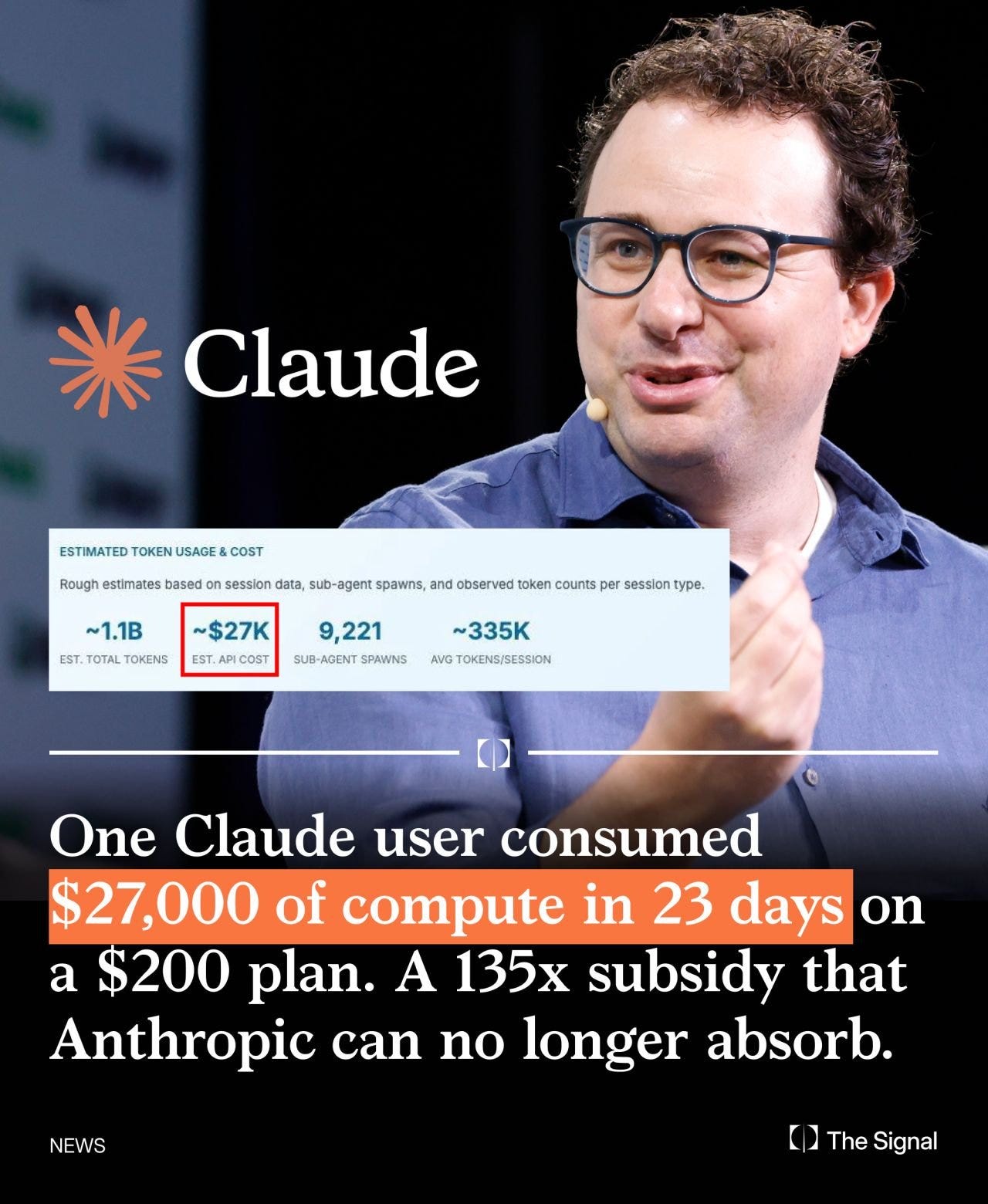
To understand why the flat-rate AI subscription is failing, look at the leaked Anthropic dashboard. An enterprise power user on a $200/month “Pro” tier ran an autonomous coding loop. In 23 days, that single user consumed 1.1 billion tokens and triggered 9,221 sub-agent tasks.
The actual compute cost of running those inferences on Anthropic’s GPU clusters was $27,000. Anthropic took a 135x loss on a single customer in less than a month.
Analyzing a 100-page PDF or running an autonomous agent isn’t a simple database query. It requires firing up clusters of GPUs and executing billions of operations. You can’t sell that kind of compute for a flat fee and hope to make it up in volume. Volume is exactly what causes the losses.
The Death of Sora
If you want proof that the subsidy is over, look at Sora.
OpenAI killed their flagship video generation model less than six months after its public launch. The tech press talked about “safety concerns” and “copyright,” but the reality was the Cost of Goods Sold (COGS).
Generating 60 frames per second of photorealistic video requires massive compute. Keeping the Sora clusters running for 500,000 active users burned an estimated $1 million a day in electricity and GPU depreciation.
They tried to pivot to the enterprise by signing a $1 billion partnership with Disney. But Disney realized that offloading their rendering pipeline to OpenAI’s servers was actually more expensive than doing it in-house. The unit economics didn’t make sense, so the servers were shut down.
OpenAI’s “Risk Factor”
The cloud providers have woken up. For years, Microsoft subsidized OpenAI’s compute to gain market share. That era of cheap infrastructure is over.
In a recent financial disclosure, OpenAI explicitly listed their reliance on Microsoft Azure’s compute pricing as a “Risk Factor.”
Wall Street is demanding a return on the billions poured into data centers. Investors are forcing AI labs to drop unprofitable consumer tools and focus entirely on enterprise contracts that actually pay the bills.
Edge vs. Mainframe
To fix the broken math, the AI market is splitting into two distinct tiers.
The middle ground which is $200/month frontier web app is disappearing.
Tier 1: The Consumer Edge
Consumers will get smaller, 8-billion parameter models running locally on their phones and laptops (Apple Silicon, Snapdragon NPUs etc).
These models are good enough for basic tasks like grammar correction and summarizing emails, but they aren’t capable of deep reasoning.
Why the shift?
Because by pushing the model to the edge, companies offload the cost of the compute and electricity directly onto the user’s battery. It is the only way the consumer unit economics work.
Tier 2: The AI Mainframe (Enterprise)
True frontier AI, massive models capable of deep, autonomous workflows will become bespoke enterprise tools.
These won’t be accessible via a casual web interface.
They will be sold via multi-million-dollar B2B contracts to pharmaceutical companies running protein simulations, and quant hedge funds executing trading logic.
They are the only businesses with gross margins high enough to afford the true, unsubsidized cost of compute.
Conclusion
The idea that a solo developer in a garage will have the exact same compute power as the CTO of JPMorgan isn’t realistic.
The physics of data centers dictate otherwise.
As a Software Architect, you need to plan defensively. Relying on cloud providers to subsidize your application’s heavy reasoning is a risk.
Build your systems around cheap, local, open-source models for the basic plumbing such as routing, classification, and simple tasks.
Treat frontier API calls as an expensive, highly constrained physical resource.
Use them only when absolutely necessary and plan for AI like heavy industrial equipment.
The era of cheap, subsidized compute is over.