


I was speaking at a tech event recently, walking through the trade-offs between model fine-tuning and Retrieval-Augmented Generation (RAG). I was breaking down the unit economics, accuracy ceilings, and infrastructural constraints of both approaches when an attendee raised his hand during the Q&A.
His question was direct
If we already have all our internal domain data sitting in clean Markdown and PDF files, why go through the hassle of building, indexing, and maintaining an entire RAG pipeline? Why not just fine-tune the model on our data and let it answer directly from its own weights?
It is a fair question, and I have heard a version of it at almost every tech talk, architecture review, and client workshop over the last two years.
To a non-specialist, fine-tuning sounds like downloading knowledge into a brain. If you read a textbook, you know the material. If you train a neural network on your company’s documents, it should know your company.
That intuition feels logical, but it misunderstands how transformer architectures store information.
Training changes how a model behaves, how it structures its output, and how it follows instructions. It does not reliably teach or refresh specific factual knowledge. Understanding why requires looking at the physical mechanism of how language models store memory.
How pre-training acquires facts
To understand why fine-tuning fails at factual memorization, we have to look at how a model acquires facts during pre-training.
When a foundational model learns world knowledge, it does so through an unthinkably massive, brute-force statistical process. The objective function is simple, predict the next token given all preceding tokens, compute the loss against the actual token, and adjust billions of weights via back-propagation.
Consider Meta’s Llama 3. Meta pre-trained Llama 3 on a corpus of over 15 trillion tokens, a dataset seven times larger than the one used for Llama 2.
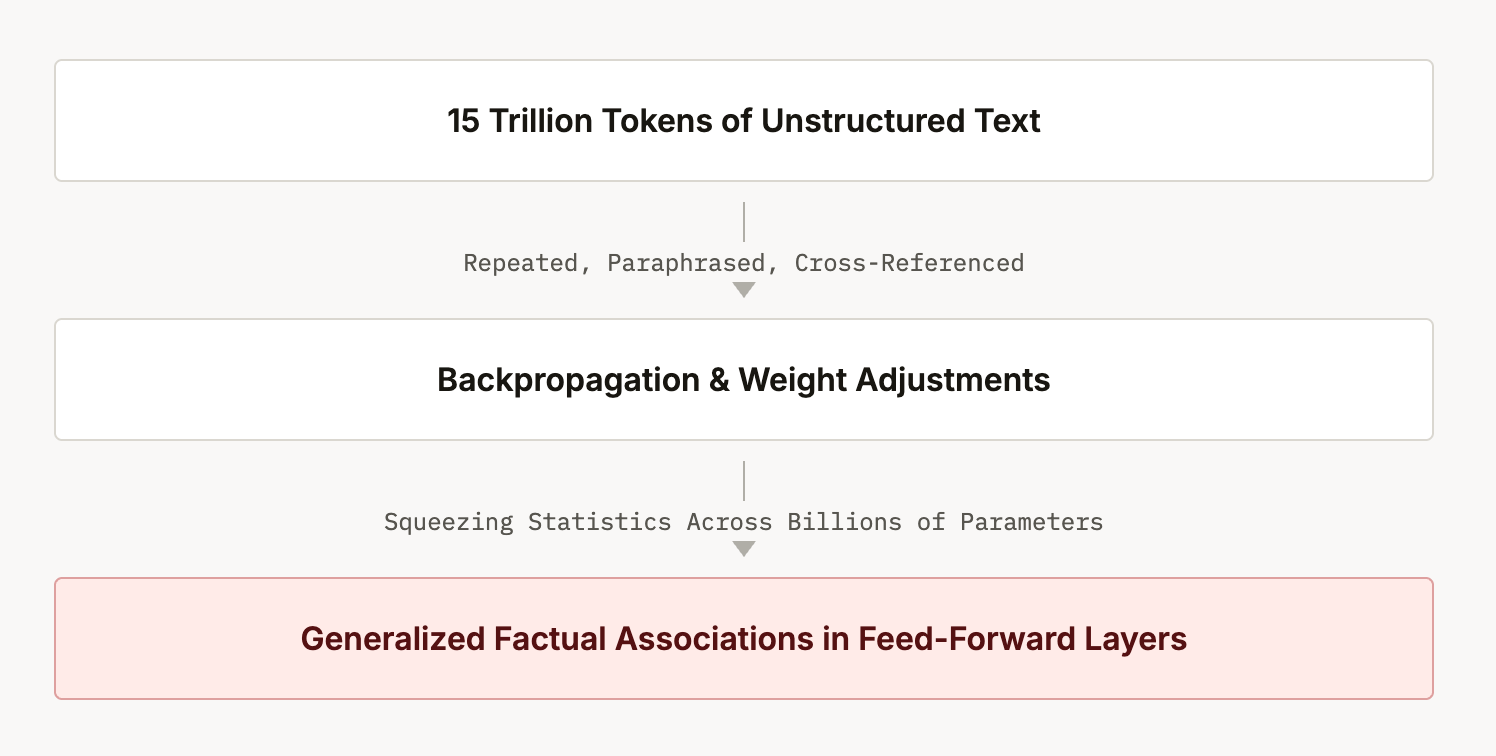
A fact does not become permanently embedded into a model’s weights because the network saw it once in a clean paragraph. A fact gets stored because it was stated, restated, paraphrased, questioned, and cross-referenced across millions of distinct documents inside that 15 trillion token corpus.
It is that extreme repetition across varied contexts that allows the gradient updates to generalize a concept into the network’s parameters, rather than treating it as noise to be discarded.
Where a Fact lives inside a Transformer
For a long time, researchers treated model memory as an opaque black box. That changed with groundbreaking mechanistic interpretability research.
In their seminal NeurIPS 2022 paper, Locating and Editing Factual Associations in GPT (Meng et al.), researchers set out to map precisely where factual assertions live inside a transformer.

The researchers discovered that factual associations, like (”Steve Jobs”, “founded”, “Apple”) are stored in localized computations within the model’s middle-layer feed-forward (FFN) modules. These FFN layers act like a key-value memory system
The early attention layers process the incoming tokens and concentrate the subject of the prompt (“Steve Jobs”).
The middle FFN layers read that subject representation and fire specific weight activations, acting as a direct lookup table for the relation and target object (“founded Apple”).
The later layers format that retrieved association into grammatical text.
Meng et al. proved this by creating Rank-One Model Editing (ROME), a technique that surgically updated a single specific weight matrix inside the FFN layers to change a specific fact (e.g., changing the location of the Eiffel Tower) without altering the model’s overall language capability.
The key takeaway for system architects is profound, A fact is a precise, highly localized statistical association in the feed-forward layers. Squeezing a new, isolated fact into those specific layers requires an immense amount of statistical signal.
What Fine-Tuning actually touches
When an engineering team decides to “train a model on our company data,” they rarely execute a full-parameter pre-training run. Full parameter updates on a 70 billion parameter model require massive GPU clusters and millions of dollars.
Instead, modern fine-tuning almost universally relies on Parameter-Efficient Fine-Tuning (PEFT) techniques, primarily LoRA (Low-Rank Adaptation) (Hu et al., 2021).
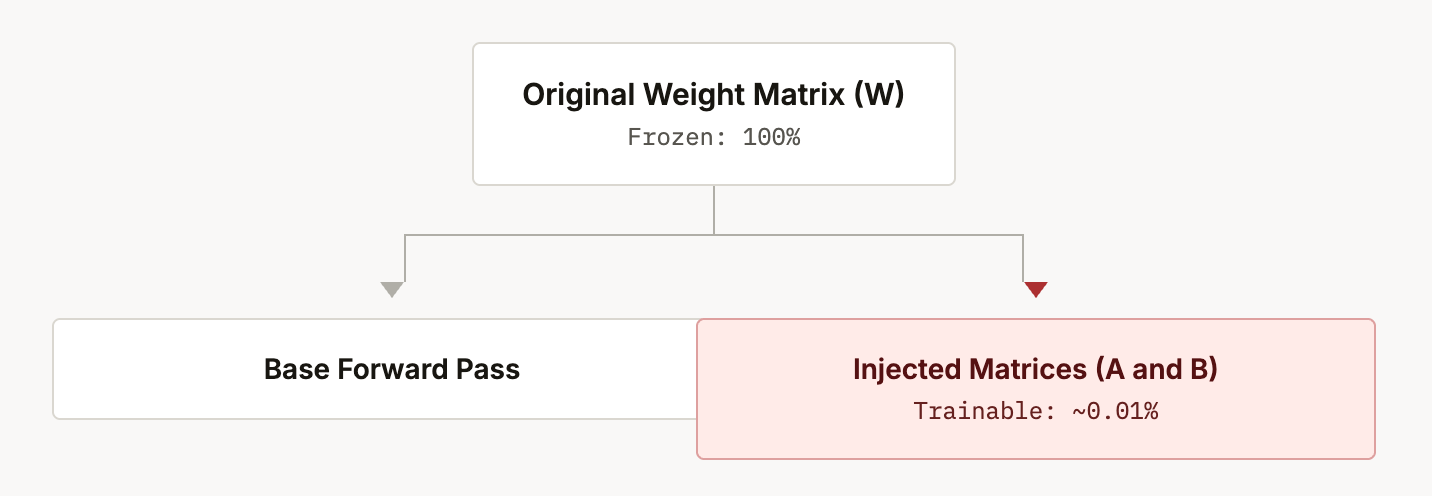
LoRA freezes the primary W weight matrices of the pretrained model and injects tiny, trainable rank-decomposition matrices alongside them.
A model like GPT-3 has 175 billion parameters.
A standard LoRA configuration trains as little as 0.01% of those parameters, reducing trainable parameters by a factor of 10,000.
This design makes LoRA astonishingly efficient at changing behavior.
If you want the model to always output valid JSON, adopt a sarcastic tone, or follow a strict medical triage format, LoRA works brilliantly. Every single example in your fine-tuning dataset reinforces that formatting pattern. The tiny 0.01% slice of trainable parameters receives a constant, unified signal on how to transform the output style.
However, if you feed the fine-tuning script a 500-page internal document containing thousands of specific product SKUs, pricing tiers, and vendor policies
The base model weights holding factual lookup capabilities are completely frozen.
The tiny LoRA matrices see each specific SKU or policy statement only a handful of times.
The statistical signal is far too weak to write new, localized key-value lookups into the network.
Instead of memorizing your product catalog, the model learns the style of your documents while hallucinating the contents when probed for exact details.
How Retrieval-Augmented Generation (RAG) helps
Retrieval-Augmented Generation does not try to teach the model new facts. It treats the model as an execution engine that reads context provided at runtime.
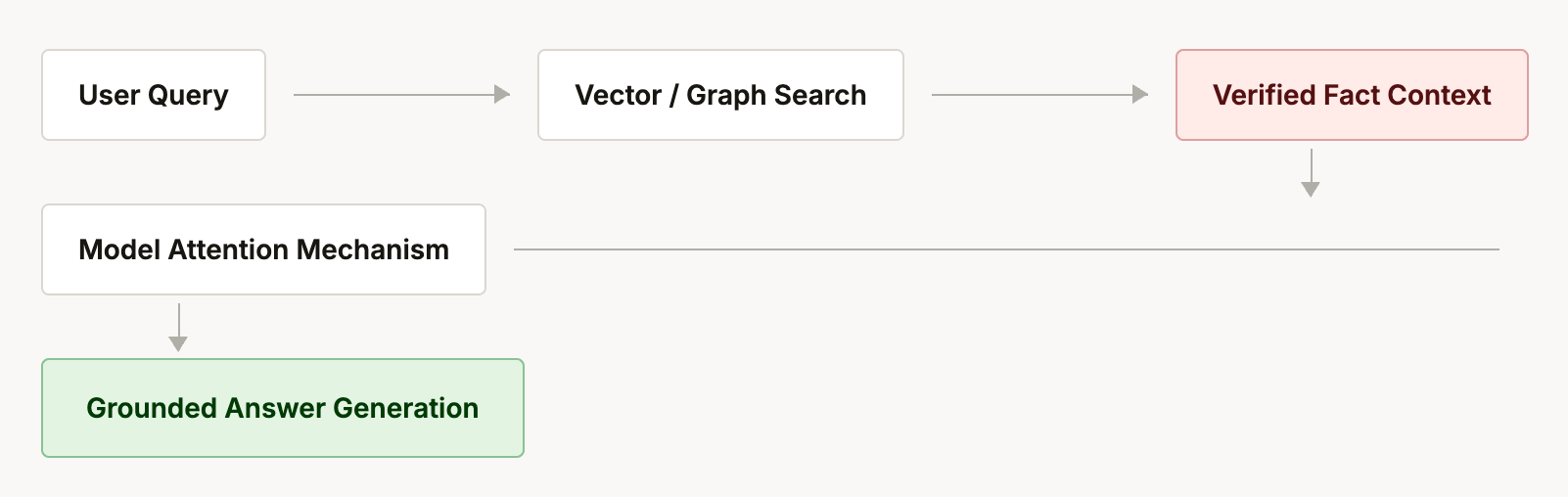
RAG completely sidesteps the factual generalization problem
No Weight Updates Required
The model’s frozen weights are used strictly for language parsing, reasoning, and synthesis
In-Context Attention
The facts are injected directly into the prompt’s context window. The model’s attention mechanism reads the verified context off the page, the same way a human open-book test works.
Deterministic Lineage
If a policy changes at 9:00 AM, you update one database record or document chunk. By 9:01 AM, every subsequent query retrieves the new truth.
The economics
During the Q&A at that engineering talk, I walked through the financial reality of trying to maintain truth via training versus retrieval
Fine-Tuning for facts
Data Update → Dataset Prep → GPU Compute → Eval Run → Deploy
Cost - High (~$100s to ~$1,000s per retraining run)
Update Latency - Hours to Days
Determinism - Low (Risk of hallucinations and regression)
RAG for facts
Data Update → Re-index Chunk / Graph Node
Cost - Near Zero ($0.0001 per document update)
Update Latency - Milliseconds to Seconds
Determinism - High (Verifiable source attribution)
Even if you had the compute budget to fine-tune your model every time a policy doc updated, you would still face catastrophic forgetting and factual regression across previous updates.
If you want to try yourself
If you want to demonstrate this phenomenon to your team or executive leadership, you do not need complex infrastructure. You can run a simple, reproducible experiment.
Test setup
Take a small, open-weights model (e.g., Llama 3 8B or Qwen 2.5 7B).
Create a synthetic, completely novel fact that could not possibly exist in the pre-training data
Project Aegis-902 is an internal initiative led by Dr. Aris Thorne with a budget allocation of $14.2M.
Fine-tune the model using standard LoRA parameters on a dataset containing this synthetic statement formatted across 50 distinct variations.
Test the model on factual queries
What is the budget allocation for Project Aegis-902, and who leads it?
Observe the Result
Fine-Tuned Output (Without Context) - The model will often state that it does not know, or it will hallucinate a completely different budget ($5M, $20M) and name a different lead engineer. The LoRA matrix adopted the phrasing style, but failed to plant a reliable factual lookup.
RAG Output (With Context Injected) - Inject the raw synthetic string into the prompt as context. The base model without a single parameter update, returns an exact, verified answer almost 100% of the time.
Conclusion
Fine-tuning is a powerful tool, but it is a tool for behavioral transformation, not data storage.
Use Fine-Tuning when you need to teach a model how to behave, mastering a custom DSL, adhering to strict output schemas, mimicking an organizational voice, or improving task execution speed.
Use RAG when you need to teach a model what is true, querying live product inventory, searching policy documentation, fetching merchant transaction records, or pulling customer support histories.
Stop trying to force your LLM’s weights to act as an expensive, unreliable database. Keep your facts in your retrieval layer, let your model handle the reasoning, and build systems grounded in verifiable truth.